

ArticlesBilingual Wedding in Brazil: Ceremony and Cartório
A Bilingual Wedding in Brazil: the Ceremony and the Civil Wedding at the Cartório
· Benedikt Schober
- about 80
- guests, one interpreter, no equipment
- up to 5 days
- from the complete file to the certificate
- 90 days
- validity of the certificate of habilitação
- 2 or 4
- witnesses: at the cartório or in a private building
In 30 seconds
- At the party, the couple chooses the interpreter; at a São Paulo cartório, a public translator interprets when a partner speaks no Portuguese and the registrar or Juiz de Casamento cannot follow that language (Corregedoria rules, chapter XVII; Lei 14.195/2021, art. 26, III).
- The foreign partner's papers need an apostille or consular legalization abroad and a Portuguese translation by a Brazilian public translator; some cartórios also ask for registration at the RTD.
- The slow part comes before the cartório: apostilles and translations of the foreign papers; once the file is complete, the certificate of habilitação follows within days.
- A religious wedding counts as the civil one only with the habilitação and its registration at the cartório (Civil Code, arts. 1.515 and 1.516).
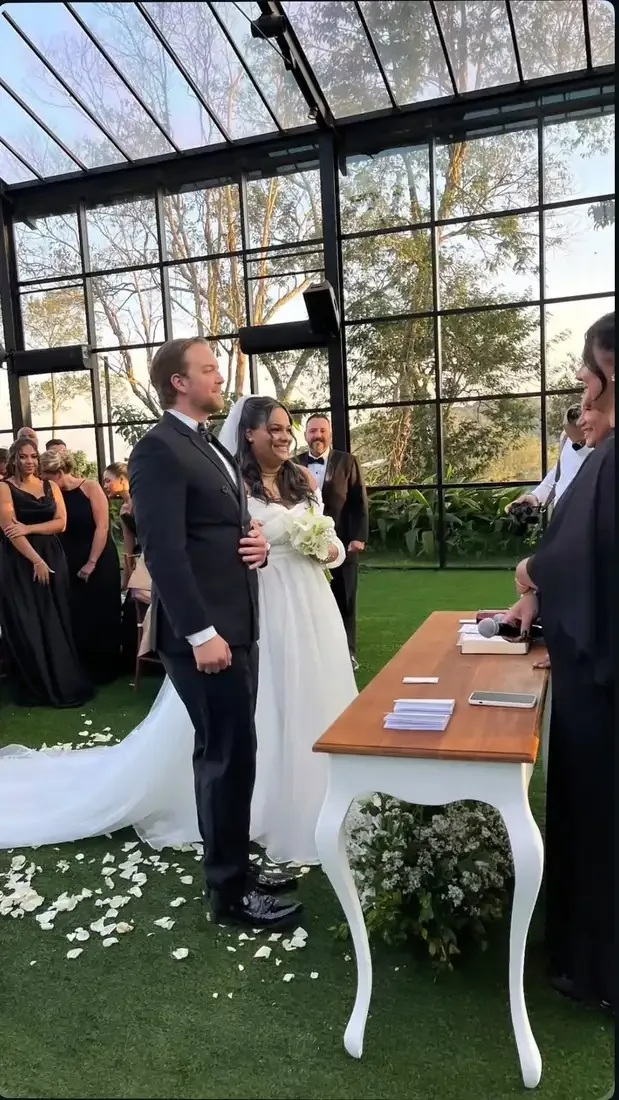
One interpreter stood beside the celebrant, close enough to catch every pause, and around 80 guests heard the ceremony twice: once in Portuguese, once in English. That was the setup at Mirante Juruá in Mairiporã, in the Serra da Cantareira north of São Paulo, on Saturday, 15 August 2026, with one of our interpreters. What happens at the vows depends on the couple; what happens at the cartório, before or after the party, does not.
At a social wedding ceremony in Brazil, the couple picks the interpreter; at a civil wedding in a São Paulo cartório, the Corregedoria's registry rules (chapter XVII) require a tradutor público (public translator) to interpret whenever one partner speaks no Portuguese and either the Juiz de Casamento or the registrar cannot follow that partner's language.
Service pageInterpreter for the ceremony, public translator for the cartórioCeremony and party from R$ 2,000 per interpreter and day, public translator at the civil act from R$ 1,000, in English and Spanish.See prices and how to book →
The ceremony with the vows
The guests were a mixed Brazilian and English-speaking crowd, and the interpretation ran from Portuguese into English throughout. There was no booth, no headsets and no receivers. With one language direction and a celebrant and couple who spoke in turn, consecutive interpreting fit the ceremony: the celebrant speaks, the interpreter renders it, and both groups follow the same moment in sequence. After the ceremony, the couple invited the interpreter to stay for dinner.
We asked our interpreter to write down her account of the ceremony. Translated from Portuguese: "We had time to talk and to breathe together before the ceremony. By the time it began, we understood each other's rhythm, and we carried each moment the way it needed to be carried." And: "Everyone was open hearted, welcoming and generous, and the planning team was excellent throughout the whole process." The bride's summary was two words: "foi ótimo".
What was settled before the day
Much of the quality of an interpreted ceremony is settled in the weeks before it, and preparation follows the same steps for every couple. The couple chooses the interpreter from a profile with photo, background and a voice sample, because for half the guests that voice becomes the voice of the ceremony. The order of service, the readings, the vows and the names of parents and grandparents arrive weeks in advance, with the pronunciation of each name.
The couple also decides what gets interpreted. Interpreting every second lengthens a ceremony, so the celebrant's words, the vows and the exchange of rings can be interpreted while music and silences stay as they are. The planner fixes where the interpreter stands, when she steps in and how she stays out of the photographer's frame. The interpreter's own highlight was how well the planning team worked, which is what coordination before the guests arrive looks like on the day.
Had a second foreign language been needed at the same ceremony, two interpreters speaking at once would have needed a portable transmitter and receivers, the setup of simultaneous interpreting. Interpreting is not limited to English: a wedding interpreter in Brazil can work in Spanish, German, French, Italian and other languages with the same preparation.

The civil wedding at the cartório
A marriage with legal effect in Brazil goes through a civil registry office, the cartório, and there, if a partner does not speak Portuguese, the interpreter is no longer the couple's choice, as it was at the celebration in Mairiporã. São Paulo's registry rules (Normas de Serviço da Corregedoria Geral da Justiça, chapter XVII, items 56.1 and 84) require a public translator to act as interpreter, both at the habilitação, the paperwork before the wedding, and at the celebration, whenever a partner does not speak Portuguese and the registrar or the Juiz de Casamento does not understand that partner's language. Where no public translator is available locally, the registrar may accept another capable person. The act itself records the translator's participation and identification, so the cartório books that person together with the date, not on the day.
Public translator, under São Paulo's rules
- Habilitação the paperwork at the cartório
- Civil celebration at the cartório, at the venue or by video
The couple chooses
- Social ceremony vows, readings, speeches
- Religious ceremony no rule found
- Party toasts and table talk
Federal law gives the same professional this role: interpreting before a public body for a person "que não domine a língua portuguesa" is listed among the tasks reserved to the tradutor e intérprete público when no public agent can do it or a specific law requires it (Lei 14.195/2021, art. 26, III). Which birth certificate a foreign partner brings, and how it is translated, is covered in our guide to birth certificate translation. If that partner's papers are in Arabic, our Portuguese-language guide to sworn Arabic translation shows which countries use the apostille and which require legalization.
A religious wedding can have civil effect, but only after the same habilitação at the cartório and registration afterwards (Civil Code, arts. 1.515 and 1.516), so, in São Paulo, the interpreter rule for the habilitação applies there too. For a purely social ceremony like the one at Mirante Juruá, we found no rule about interpreters. And since 2022 the civil celebration can take place by videoconference at the couple's request, provided the free consent of both can be verified (Lei 6.015/1973, art. 67, § 8º); in that case the public translator joins the same call, on screen beside the registrar rather than beside a celebrant.
What does the foreign partner bring to the habilitação?
For a bilingual wedding in Brazil, the foreign partner brings the papers the Civil Code lists for the habilitação (art. 1.525): a birth certificate or equivalent document, a statement of marital status and residence, the declaration of two adult witnesses and, after an earlier marriage, proof that it ended. Every document issued abroad needs an apostille, or consular legalization where the issuing country is not part of the Apostille Convention, and a Portuguese translation by a Brazilian public translator, because documents in a foreign language must be translated into Portuguese to have legal effect in Brazil (Civil Code, art. 224).
What a cartório usually asks of the foreign partner
- Passport, or the Brazilian migration ID (RNM) for residents
- Birth certificate or equivalent document (art. 1.525, I), with apostille or legalization and a Portuguese translation
- Statement of marital status, domicile and residence of both partners and their parents (art. 1.525, IV)
- After an earlier marriage: the divorce record, the annulment ruling or the former spouse's death certificate (art. 1.525, V)
- Two adult witnesses, relatives or not, for the declaration of art. 1.525, III
São Paulo is more flexible about the birth certificate. Its Corregedoria rules (chapter XVII, item 56) let a foreign partner prove age, marital status and parentage with the Brazilian ID for foreigners (today the RNM), a passport with the visa still valid, a consular certificate, or a birth certificate translated and registered at the Registro de Títulos e Documentos (RTD), the registry for documents. Other states keep their own lists, so the first visit to the cartório is the moment to ask which papers it accepts and whether it wants the translations registered at the RTD.
A divorce abroad needs one more question. A consensual foreign divorce takes effect in Brazil without recognition by the Superior Tribunal de Justiça (Code of Civil Procedure, art. 961, § 5º); other foreign judgments, as a rule, only take effect after that recognition (art. 961). Under the CNJ's rules for registry offices, the direct route covers a simple consensual divorce, one that only ends the marriage; a decree that also settles custody, support or property goes to the STJ first (Provimento CNJ 53/2016, now part of the Código Nacional de Normas, Provimento CNJ 149/2023). Ask the cartório which version of the divorce decree it needs before you order the apostille.
At traduzme, a birth certificate translated from English into Portuguese costs R$ 129, and so does a divorce certificate in the same direction; the price calculator shows other languages and the delivery date before you pay. For papers in English, our page on sworn translation English–Portuguese explains the apostille country by country.
From papers to “I do”: the timeline of a bilingual wedding in Brazil
A bilingual wedding in Brazil with legal effect follows one of three routes, and on all three the clock starts when the cartório has the complete file: the certificate of habilitação comes within up to five days (Lei 6.015/1973, art. 67, § 1º, in the wording of Lei 14.382/2022) and is valid for 90 days (Civil Code, art. 1.532). Who interprets changes from step to step.
Three routes to a marriage with legal effect
Each route lists its steps, the deadline, the rule behind it and who interprets there. The public translator marks follow São Paulo's rules.
- Public translator
- Couple's choice
- Translation on paper
- No interpreting
Civil wedding at the cartório or with the Juiz de Paz at the venue
- About 3 months beforePapers from abroadApostille or consular legalization in the issuing country, then the Portuguese translation in Brazil.Translation on paperCivil Code, art. 224
- 60 to 90 days before (our advice)HabilitaçãoBoth partners file at the registry of the district where one of them lives, with the witnesses' declaration.Public translatorCivil Code, arts. 1.525 and 1.526; Lei 6.015, art. 67
- Up to 5 days laterCertificate of habilitaçãoPublished electronically; from its date, 90 days to marry.No interpretingLei 6.015, art. 67, § 1º; Civil Code, art. 1.532
- Within the 90 daysCivil celebrationAt the cartório with two witnesses, in a private building such as the venue with four, or by videoconference if the couple asks.Public translator, named in the actCivil Code, arts. 1.533 and 1.534; Lei 6.015, art. 67, § 8º
- Same day or laterCeremony and partyVows, readings and speeches in both languages.Couple's choiceNo rule found
Religious ceremony with civil effect, habilitação first
- About 3 months beforePapers from abroadThe same apostille or legalization and Portuguese translation as for the civil wedding.Translation on paperCivil Code, art. 224
- 60 to 90 days before (our advice)HabilitaçãoAsk for the certificate for a religious celebration, which states how long it is valid.Public translatorCivil Code, art. 1.516; Lei 6.015, art. 71
- Up to 5 days laterCertificate for the celebrantThe religious ceremony has to fall inside its 90 days.No interpretingLei 6.015, art. 67, § 1º; Civil Code, art. 1.532
- Within the 90 daysReligious ceremonyA priest, pastor, rabbi or other minister celebrates; the religious record is signed there.Couple's choiceCivil Code, art. 1.515
- Within 90 days of the ceremonyRegistration at the cartórioRequested by the celebrant or anyone interested; the marriage counts from the ceremony date. Later than that, a new habilitação.No interpretingCivil Code, art. 1.516, § 1º; Lei 6.015, art. 73 still says 30 days
Religious ceremony first, civil registration later
- Any dateReligious ceremonyCelebrated without a habilitação: no civil effect yet.Couple's choiceCivil Code, art. 1.516, § 2º
- Whenever you decidePapers from abroadApostille or legalization and the Portuguese translation, as on the other routes.Translation on paperCivil Code, art. 224
- At any timeHabilitaçãoThe couple asks for the religious marriage to be registered, with proof of the religious act.Public translatorCivil Code, art. 1.516, § 2º; Lei 6.015, art. 74
- Up to 5 days laterCertificate of habilitaçãoThe registration has to happen inside its 90 days.No interpretingLei 6.015, art. 67, § 1º; Civil Code, art. 1.532
- Within the 90 daysRegistration at the cartórioThe religious marriage enters the civil register and counts from the ceremony date.No interpretingCivil Code, arts. 1.515 and 1.516, § 2º
Lists of papers, fees and how each cartório handles the public notice vary; confirm them with your cartório at the first visit.
The Civil Code still prints the older 15-day public notice, the edital de proclamas (art. 1.527). Since Lei 14.382/2022, the registrar publishes the habilitação electronically and issues the certificate within the five-day limit, so ask the cartório for the expected certificate date when you file.
On the day, the civil celebration needs two witnesses at the cartório and four when it takes place in a private building, such as the party venue, or when a partner cannot write; the witnesses may be relatives (Civil Code, art. 1.534). It happens on the day, at the time and in the place set by the authority that presides over it (art. 1.533), which is why the public translator's date is booked together with the cartório's. For a wedding in Rio de Janeiro, our Portuguese guide counts the weeks back for you: marrying a foreigner in Rio, week by week.
Can a church wedding in Brazil also be the legal one?
Yes: a religious wedding has civil effect when the couple completes the habilitação at the cartório and the marriage is registered there, and it then counts from the date of the religious ceremony (Civil Code, arts. 1.515 and 1.516).
With the habilitação done first, the cartório issues the certificate for a religious celebration, stating how long it is valid (Lei 6.015/1973, art. 71). The celebrant performs the ceremony while that certificate is valid, and the celebrant or anyone interested then requests the registration within the deadline shown above (Civil Code, art. 1.516, § 1º). The Public Registries Law still gives 30 days for that request (Lei 6.015/1973, art. 73), so asking for the registration in the first weeks avoids any doubt.
A religious wedding celebrated without a habilitação can be registered later, at any time, at the couple's request, after a habilitação and within the validity of its certificate (Civil Code, art. 1.516, § 2º). For the religious ceremony itself we found no rule on who interprets: as at Mirante Juruá, the couple chooses. In São Paulo, the public translator rule attaches to the habilitação and to the civil celebration, not to the church.
What if there is no public translator for our language?
If no public translator works in your language, the authority can designate another interpreter for that act: the law reserves interpreting before a public body to the public translator, but when no public translator is qualified in the language, or the one available is impeded or unavailable, the competent authority may designate someone else for the case (Lei 14.195/2021, art. 26, sole paragraph). That interpreter, called ad hoc, acts for that wedding only, a case that matters at a bilingual wedding in Brazil when the language has few public translators.
Before it comes to that, look further than your own state. Public translators are registered with the Junta Comercial of their state, but they may work in any state (Lei 14.195/2021, art. 24), so one from another state can travel to the cartório or join a celebration held by videoconference.
If the foreign partner cannot be in Brazil on the day, the civil wedding can be celebrated through a public power of attorney with special powers, valid for no more than 90 days (Civil Code, art. 1.542). A power of attorney signed abroad then goes through the same apostille and translation as the other papers, and São Paulo also asks for its registration at the RTD (chapter XVII, item 83.2), as our Portuguese guide on a power of attorney made abroad explains.
- Check the Junta lists Each Junta Comercial publishes its public translators by language; one registered in any state may act (Lei 14.195/2021, art. 24).
- Name the language early At the first visit, so the cartório can say whether it needs the interpreter at the habilitação, the celebration or both.
- No one for the language? The authority can designate an interpreter for that act only (art. 26, sole paragraph).
- Book with the date The act records who interpreted, so the interpreter is fixed when the cartório sets day and time.
Sources checked on 10 November 2026: Civil Code (Lei 10.406/2002), arts. 224, 1.515, 1.516, 1.525 to 1.534 and 1.542; Lei 6.015/1973 (Public Registries Law), arts. 67 (§§ 1º and 8º, wording of Lei 14.382/2022), 71, 73 and 74; Lei 14.195/2021, arts. 24 and 26; Code of Civil Procedure (Lei 13.105/2015), art. 961; Provimento CNJ 53/2016 (foreign consensual divorce, now in Provimento CNJ 149/2023); Corregedoria Geral da Justiça de São Paulo, Normas de Serviço, chapter XVII, items 56 and 56.1 (habilitação), 83.2 (power of attorney) and 84 (celebration); Decreto 8.660/2016 (Apostille Convention in Brazil); traduzme prices for translations (birth and divorce certificates, English → Portuguese) and for the wedding service, November 2026.
Frequently asked questions
Questions couples ask about the interpreter, the cartório and the religious wedding in Brazil.
Yes, if that interpreter is a tradutor público for your language: in São Paulo the cartório calls for a public translator when a partner does not speak Portuguese and the registrar or Juiz de Casamento cannot follow that language (or another capable person where none is available locally), while the social ceremony has no such requirement. If the interpreter at the party is not a public translator, the cartório is booked with one separately.
In Brazil, we found no rule requiring it for a social or religious ceremony: the couple chooses who interprets the vows, readings and speeches. For a religious wedding with civil effect, the public translator rule applies at the habilitação at the cartório, the paperwork before the wedding, not at the altar or in the garden.
Only if you want her to be. Where the interpreter stands is agreed with your planner and photographer before the day, usually a little behind and to the side of the celebrant, so she can step out of the frame at the moments that matter, such as the vows, the rings and the kiss.
Yes, but only the parts you choose to interpret get longer, because each passage is heard twice. Couples decide this with the interpreter beforehand, for example the celebrant's words, the vows and the exchange of rings, while music, the entrance and moments of silence stay as they are and take no extra time.
In Brazil, once the cartório has the complete file, the certificate of habilitação comes within up to five days (Lei 6.015/1973, art. 67, § 1º) and allows the wedding for 90 days (Civil Code, art. 1.532). The longer part comes first: the apostilles abroad and the translation of the foreign partner's papers. We suggest starting about three months ahead and filing 60 to 90 days before the date.
In Brazil, a church or other religious wedding is legally valid when the couple completes the habilitação at the cartório and the marriage is then registered there; it counts from the date of the ceremony (Civil Code, arts. 1.515 and 1.516). The registration is requested within 90 days of the ceremony. A religious wedding held without a habilitação has no civil effect until it is registered later, after a habilitação.