Sworn translation English–Portuguese,for use in Braziland abroad.
Your document translated and digitally signed by a Brazilian sworn translator (tradutor juramentado) – at a fixed, published price with no hidden costs.
Where will you use your Brazilian document?Where is your document from?
Pick the country to see what to do with a Brazilian document before using it there: apostille, sworn translation into English and what the authority there requires.Pick the country to see what to do before the sworn translation – and how to use a Brazilian document there.
e-Apostila in Brazil, where the authority asksLegalisation at Itamaraty and the embassy
Apostille is enoughLegalisation neededSpecial route
United States
e-Apostila in BrazilApostille only
Brazilian certificates, diplomas, transcripts or police records for use in the United States: the steps before you submit them. Used for: Immigration and green card (USCIS), immigrant visa (NVC and US consulate, form DS-260), study (universities and credential evaluators such as WES and ECE), professional licences (state licensing boards)
Birth, marriage or divorce certificate, diploma, transcript or police certificate from the United States: what to do before the sworn translation so it is valid in Brazil. Apostille (US a party since 15 Oct 1981; with Brazil since 14 Aug 2016)
Brazilian certificates, diplomas, transcripts or police records for use in the United Kingdom: the steps before you submit them. Used for: Visas and immigration (UKVI/Home Office), qualification recognition (UK ENIC), marriage notice at a register office (England and Wales), employers and professional bodies
Birth, marriage or divorce certificate, diploma, transcript or police certificate from the United Kingdom: what to do before the sworn translation so it is valid in Brazil. Apostille (since 14 Aug 2016 with Brazil)
Brazilian certificates, diplomas, transcripts or police records for use in Canada: the steps before you submit them. Used for: Permanent immigration, study and work permits and citizenship (IRCC), educational credential assessment for Express Entry (ECA, e.g. WES Canada), Quebec (MIFI) and provincial professional regulators
Birth, marriage or divorce certificate, diploma, transcript or police certificate from Canada: what to do before the sworn translation so it is valid in Brazil. Apostille (since 11 Jan 2024)
Brazilian certificates, diplomas, transcripts or police records for use in Australia: the steps before you submit them. Used for: Visas and citizenship (Department of Home Affairs, via ImmiAccount), skills assessment and professional registration (assessing authorities, AHPRA and other boards), study (universities)
Birth, marriage or divorce certificate, diploma, transcript or police certificate from Australia: what to do before the sworn translation so it is valid in Brazil. Apostille (since 14 Aug 2016 with Brazil)
Brazilian certificates, diplomas, transcripts or police records for use in Ireland: the steps before you submit them. Used for: Immigration and visas (Immigration Service Delivery – ISD), citizenship by naturalisation (ISD) and by descent (Foreign Births Register, DFA), marriage (HSE Civil Registration Service), qualification recognition (QQI/NARIC Ireland)
Birth, marriage or divorce certificate, diploma, transcript or police certificate from Ireland: what to do before the sworn translation so it is valid in Brazil. Apostille (since 14 Aug 2016 with Brazil)
Brazilian certificates, diplomas, transcripts or police records for use in New Zealand: the steps before you submit them. Used for: Visitor, student, work and residence visas (Immigration New Zealand – INZ); qualification recognition and professional registration (own bodies); citizenship (Department of Internal Affairs)
Birth, marriage or divorce certificate, diploma, transcript or police certificate from New Zealand: what to do before the sworn translation so it is valid in Brazil. Apostille (since 14 Aug 2016 with Brazil)
Brazilian certificates, diplomas, transcripts or police records for use in South Africa: the steps before you submit them. Used for: Temporary visas and permanent residence (Department of Home Affairs – DHA; applications via the embassy in Brasília or consulate in São Paulo), qualification evaluation (SAQA), study and work
Birth, marriage or divorce certificate, diploma, transcript or police certificate from South Africa: what to do before the sworn translation so it is valid in Brazil. Apostille (South Africa a party since 30 Apr 1995; with Brazil since 14 Aug 2016)
Brazilian certificates, diplomas, transcripts or police records for use in India: the steps before you submit them. Used for: OCI for spouses of Indian nationals and visas (Embassy in Brasília / Consulate-General in São Paulo), employment (E) visa, foreigner registration in India, study and employment
Birth, marriage or divorce certificate, diploma, transcript or police certificate from India: what to do before the sworn translation so it is valid in Brazil. Apostille (India a party since 14 Jul 2005; with Brazil since 14 Aug 2016)
Brazilian certificates, diplomas, transcripts or police records for use in Nigeria: the steps before you submit them. Used for: Employment (STR) visa and CERPAC residence permit (Nigeria Immigration Service), employment, study and marriage
Birth, marriage or divorce certificate, diploma, transcript or police certificate from Nigeria: what to do before the sworn translation so it is valid in Brazil. Consular legalisation (not a party to the Apostille Convention)
Brazilian certificates, diplomas, transcripts or police records for use in Ghana: the steps before you submit them. Used for: Residence and work permits (Ghana Immigration Service), dependant residence (spouse, children), study and employment
Birth, marriage or divorce certificate, diploma, transcript or police certificate from Ghana: what to do before the sworn translation so it is valid in Brazil. Consular legalisation (not a party to the Apostille Convention)
Brazilian certificates, diplomas, transcripts or police records for use in Kenya: the steps before you submit them. Used for: Work and residence permits (Department of Immigration, eFNS portal), study, employment and marriage
Birth, marriage or divorce certificate, diploma, transcript or police certificate from Kenya: what to do before the sworn translation so it is valid in Brazil. Consular legalisation (not a party to the Apostille Convention)
Brazilian certificates, diplomas, transcripts or police records for use in Singapore: the steps before you submit them. Used for: Permanent residence, Long-Term Visit Pass and citizenship (ICA); work and dependant passes (Ministry of Manpower – MOM); study
Birth, marriage or divorce certificate, diploma, transcript or police certificate from Singapore: what to do before the sworn translation so it is valid in Brazil. Apostille (in force with Brazil since 16 Sep 2021)
Brazilian certificates, diplomas, transcripts or police records for use in the Philippines: the steps before you submit them. Used for: 13(a) resident visa for spouses of Filipinos (Bureau of Immigration, applied via a Philippine embassy), marriage (local civil registrar), study and work
Birth, marriage or divorce certificate, diploma, transcript or police certificate from the Philippines: what to do before the sworn translation so it is valid in Brazil. Apostille (in force with Brazil since 14 May 2019)
Brazilian certificates, diplomas, transcripts or police records for use in Jamaica: the steps before you submit them. Used for: Work permit (Ministry of Labour and Social Security – MLSS), immigration and citizenship (PICA), marriage (Registrar General's Department), study
Birth, marriage or divorce certificate, diploma, transcript or police certificate from Jamaica: what to do before the sworn translation so it is valid in Brazil. Apostille (in force with Brazil since 3 Jul 2021)
Brazilian certificates, diplomas, transcripts or police records for use in Trinidad and Tobago: the steps before you submit them. Used for: Visas, residence and work permits (Immigration Division, Ministry of National Security; visas also via T&T missions), marriage (Registrar General's Department), study
Birth, marriage or divorce certificate, diploma, transcript or police certificate from Trinidad and Tobago: what to do before the sworn translation so it is valid in Brazil. Apostille (Trinidad and Tobago party since 14 Jul 2000; with Brazil since 14 Aug 2016)
Brazilian certificates, diplomas, transcripts or police records for use in Guyana: the steps before you submit them. Used for: Work permits and immigration (Ministry of Home Affairs), marriage and civil registration (General Register Office), study and employment
Birth, marriage or divorce certificate, diploma, transcript or police certificate from Guyana: what to do before the sworn translation so it is valid in Brazil. Apostille (in force with Brazil since 18 Apr 2019)
Brazilian certificates, diplomas, transcripts or police records for use in Malta: the steps before you submit them. Used for: Residence and work permits (Identità – Expatriates Unit, Single Permit), civil registration and marriage (Identità – Public Registry, Marriage Registry), qualification recognition (MQRIC/MFHEA)
Birth, marriage or divorce certificate, diploma, transcript or police certificate from Malta: what to do before the sworn translation so it is valid in Brazil. Apostille (since 14 Aug 2016 with Brazil)
A large order? Send everything at once and get one fixed offer.
For court cases, probate, a whole family’s immigration or company documents: upload all files, choose the deadline and receive a single quote by email – no commitment.
Ideal for
Court cases
Probate
Family immigration
Companies and contracts
Upload the filesPDF, photo or Word – up to 20 files at once.
The sworn translator reviews themand sets the price and delivery date.
You receive the offer by emailand accept it with one click, via WhatsApp or email.
Private storage – no public links
Your contact details stay with traduzme only
Nothing is charged before you accept
How it works
Sworn translation English into Portuguese and Portuguese into English: three steps
OriginalYour translation
Have the right document
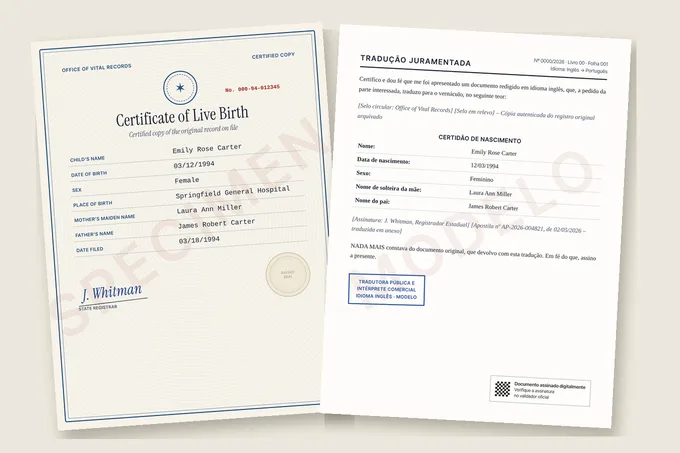
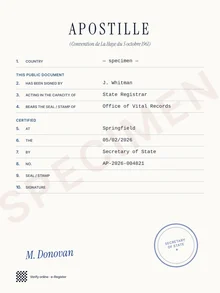
Foreign document: with the apostille of the issuing country, which we translate too. Brazilian document: we add the e-Apostila if required.
Upload and see the price
A scanned PDF is best, but a sharp phone photo works too. Fixed price straight away; pay by Pix, PayPal or bank transfer.
Receive the signed PDF
Everything translated: stamps, seals, apostille, back page. US dates (month/day) carefully converted to the Brazilian format.
People who need a sworn translation in Brazil often pay too much: prices only on request, extra costs that appear later and steps that are sold but not needed. traduzme was founded in São Paulo by a German – we know this as foreigners ourselves. That is why we do it differently.
Published pricesYou see the fixed price before you upload or pay.
Best price guaranteeGot a lower quote from a sworn translator? Send it to us – we match it.
Honest, free adviceWe also tell you what you do not need – via WhatsApp, no strings attached.
All the rules, openlyThe route for each of the 17 countries, with official sources, is on its own page – free.
You pay the company onlyPix with an official invoice (nota fiscal), straight to traduzme.
Sworn English interpreter – online, by your side
For your video call with a lawyer, a notary, an online hearing or a company in Brazil: an English–Portuguese interpreter via Zoom, Google Meet, Teams or WhatsApp video. Choose the length and see the fixed price right away.
live
Zoom
Google Meet
Teams
WhatsApp
You
Lawyer
Interpreter · English ⇄ Portuguese
Choose the length and see the price
The interpreter confirms the date
You pay and the interpreter joins the call
Sworn English–Portuguese interpreter
Consecutive interpreting
Online only – from anywhere in Brazil or abroad
Fixed price – you only pay after confirmation
Questions
Frequently asked questions about sworn translation from English
Is your case different?Send a photo or PDF – we tell you for free what to do.Ask via WhatsApp
Last reviewed: 6 November 2026, by Benedikt Schober (traduzme) · Rules and addresses checked against the official sources cited for each country.
What is a sworn translation (tradução juramentada)?
A sworn translation (tradução juramentada) is a translation made and signed by a public translator and interpreter (tradutor juramentado) who passed a public exam and is registered with the Junta Comercial of their state. It has public faith and is accepted by every public body in Brazil (Law 14.195/2021). With traduzme you receive it as a digitally signed PDF. Outside Brazil, the receiving authority decides whether it accepts the translation.
How much does a sworn translation from English cost?
Prices are fixed and published. English into Portuguese: certificates, diplomas, passport and police certificates R$ 129; transcripts and powers of attorney R$ 139 + R$ 49 per extra page; other texts R$ 119 per page of text of 1,000 characters without spaces (technical R$ 139). Portuguese into English: R$ 139 and R$ 149 + R$ 49; texts R$ 119 per page of text (technical R$ 139). Apostille on the translation (only for Brazilian documents used abroad): R$ 119.
How long does it take?
4 business days for documents (long texts: 5), counted from payment. Express in 24 h (up to 10 pages) or 48 h (up to 19 pages) when there is still capacity that day – the date and the express option appear in the online quote before you pay. The apostille on the original in the issuing country takes extra time – start early.
Do I really need a sworn translation for an English document in Brazil?
As a rule, yes: to have legal effect at public offices, notaries and courts, every foreign-language document needs a sworn translation into Portuguese made in Brazil by a public translator (Code of Civil Procedure, art. 192; Law 14.195/2021). The Federal Police says so explicitly, even for apostilled documents – a certified translation from your home country is not a substitute. Important exception: for diploma revalidation, universities generally waive translation of English documents (Res. CNE/CES 2/2024).
Where do I get the apostille on my original?
It depends on where the document was issued. Foreign document for use in Brazil: the apostille is issued in the country that issued the document – in the US, usually the Secretary of State of the state that issued the certificate (federal documents such as the FBI record: the Department of State); in the UK, the FCDO Legalisation Office; in Canada, Global Affairs Canada or the province. Your embassy in Brazil cannot do it, and Brazilian notaries cannot apostille foreign documents. Brazilian document for use abroad: the apostille is issued at a cartório in Brazil, and traduzme requests the e-Apostila for you if the receiving authority requires it. Nigeria, Ghana and Kenya do not accept the apostille: there the document is legalised at Itamaraty and then at the embassy.
Is the digital translation accepted?
In Brazil: yes. Law 14.195/2021 (art. 33) allows sworn translators to work electronically; the digitally signed PDF counts like the paper copy. If a Brazilian office asks for paper, message us on WhatsApp first – a printed copy can be posted within Brazil. Abroad: the receiving authority decides. For online applications you upload the PDF; if the authority wants an apostille on the translation, we add the e-Apostila. If it requires paper, talk to us before you order.
Is the translation accepted by USCIS (USA) or IRCC (Canada)?
For USCIS, the translation must come with the translator’s Certificate of Translation – no US-based translator or notary is needed. For IRCC, because the translator is not certified in Canada, a Translator’s Affidavit sworn before an official authorised to take oaths, and a certified copy of the original are also needed. Tell us in your order that it is for IRCC: we confirm the affidavit route before you pay.
Do you also translate from Portuguese into English?
Yes, from R$ 139 – e.g. Brazilian certificates, diplomas, transcripts and police records for immigration, study or work abroad. The receiving authority decides whether it accepts the translation: for each country above we show what the official sources say, e.g. about USCIS (USA), the Home Office (UK) or IRCC (Canada).
What do I need to get married at a Brazilian notary (cartório)?
Usually your birth certificate – apostilled and with a sworn translation made in Brazil; if you were married before, also the divorce certificate or decree, or the death certificate. In São Paulo, a passport with a valid visa, a foreigner ID card or a consular declaration can replace the birth certificate (Arpen-SP Statement 59); if you use the birth certificate, in São Paulo it must also be registered at the Títulos e Documentos registry. Other states have their own rules. Ask your cartório for its list.
What do I need for residence or naturalisation?
Among other things, a police certificate from your country of origin – apostilled and with a sworn translation made in Brazil (Ordinance MJSP 623/2020). In the US that is the FBI Identity History Summary (federal apostille at the Department of State); in the UK, the ACRO Police Certificate; in Canada, the RCMP fingerprint-based check. Applications are made online on gov.br; the full lists are on the Ministry of Justice and Federal Police websites.
I want to revalidate my English-language diploma.
Public universities may require a translation, but academic lingua francas "such as" English, French and Spanish are exempt (Res. CNE/CES 2/2024, art. 4) – a university can only set this aside by its own justified decision. So English diplomas and transcripts usually need no translation – check the call (edital). Most require an apostille on the original. If the edital asks for a sworn translation, we do it from R$ 129.
How do I pay – also without a CPF or Pix?
By Pix directly to the company (Benedikt Schober LTDA, CNPJ 55.852.696/0001-76), always with an official invoice. Without a CPF or Pix, choose “I’m a foreigner” in the calculator – then you pay by PayPal or bank transfer (from abroad, e.g. via Wise). Someone else can also pay by Pix for you.
My name is spelled differently on my documents. What now?
Send us your passport page too. We use the passport spelling so that all translations match – in Brazil and abroad. Middle names, married names and suffixes like Jr. are kept as in the original.
Do I need to send the original?
Not for the translation – in both directions a scanned PDF or a sharp photo is enough. Keep the original: in Brazil the sworn translation is presented together with it; abroad, the receiving authority tells you whether it wants the original, a certified copy or only an online upload.
Is the translation valid all over Brazil?
Yes. A sworn translation is officially valid in every Brazilian state. Everything is online: São Paulo, Rio de Janeiro, Brasília, Florianópolis or any other city – and from abroad. For use outside Brazil, the receiving authority decides: see the country above.
Can I use the translation more than once?
Yes, in both directions: you can present the digitally signed PDF to several offices, in Brazil or abroad. Some ask for a recent certificate – a new certificate then needs a new translation.
Which Brazilian rules apply to every country?
The United States, the United Kingdom, Ireland, Canada (since 11 Jan 2024), Australia, New Zealand and South Africa are parties to the Apostille Convention; it has applied to Brazil since 14 Aug 2016. Public documents from these countries need only the apostille of the issuing country’s competent authority – no consular legalization. Check the HCCH table for any objection between the country and Brazil. (Source: HCCH status table; CNJ Resolution 228/2016)
Even English-language, apostilled documents need a Brazilian sworn translation by a public translator (tradutor e intérprete público) registered with a Brazilian Junta Comercial. There is no general exemption for English, and “certified translations” made abroad do not replace the Brazilian sworn translation. (Source: CPC art. 192; Law 14,195/2021 arts. 22 and 27; Federal Police FAQ)
A sworn translation carries public faith, is valid in every Brazilian state and may be issued electronically with a digital signature; the electronic version has the same validity as the paper one. (Source: Law 14,195/2021 arts. 24, 27 and 33; Law 14,063/2020)
Diploma revalidation: the public university may require a translation, but this does not apply to academic lingua francas “such as English, French and Spanish”; the university can only set this exception aside by a reasoned act of its own. Diploma and transcript still need the apostille. (Source: CNE/CES Resolution 2/2024, art. 4 §§ 6–7)
Federal Police (residence permit, RNM): foreign certificates need an apostille or legalization and a sworn translation made in Brazil; the Mercosur translation waivers do not apply to documents from English-speaking countries. Criminal record certificates are usually accepted up to 90 days after issue. (Source: Federal Police FAQ)
Registry of Deeds and Documents (RTD): foreign documents, together with their translation, are registered at the RTD to take effect against third parties and public bodies; some registry offices require this, e.g. for marriage. (Source: Law 6,015/1973 art. 129, 6º)
Marriage at a cartório: foreigners usually present an apostilled birth certificate with a sworn translation, in many states also registered at the RTD; in São Paulo a passport with a valid visa or a consular declaration can replace the birth certificate. Rules vary by state – check with the registry office. (Source: Civil Code art. 1,525; CGJ-SP Service Rules ch. XVII; ARPEN-SP Statement 59)
CPF (Federal Revenue): foreigners can register in Brazil or at Brazilian consular posts abroad; the passport is presented as identification. Ask whether any additional English-language document will need a translation. (Source: RFB Normative Instruction 2,172/2024)
Brazilian documents for English-speaking countries: the apostille only covers documents issued in Brazil, and traduzme requests the digital e-Apostila for you. On the translation, an apostille is only needed when the foreign authority asks for it. (Source: CNJ Resolution 228/2016; CNJ Apostille FAQ)
Abroad, the receiving authority decides whether a translation made in Brazil is accepted: USCIS and the UK Home Office accept translations with a translator’s statement; IRCC (Canada) also asks for a translator’s affidavit sworn before an official authorised to take oaths; Australia requires NAATI only for translations made in Australia. (Source: 8 CFR 103.2(b)(3); gov.uk; canada.ca; Australian Home Affairs/High Commission)
CRAI São Paulo – the city’s centre for immigrants: advice on documents, work and rights.
Your own embassy or consulate in Brazil – for passports, consular registrations and your own country’s documents.
We do not give legal advice on visas, residence or marriage – for that, see a lawyer or the Defensoria. You can check whether someone is a registered lawyer in the OAB national register.











 Check via WhatsApp