

Special cases in sworn translation from English
Certified translations, USCIS, IRCC and the Home Office, notarized translations, e-Apostila, diplomas, driving licences and WES – answers based on the official rules.
5 out of 5 on GoogleI have a “certified translation” made in the US (or UK). Is it valid in Brazil?
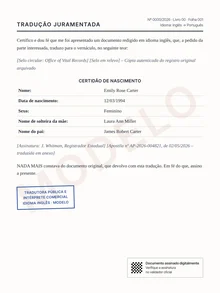
As a rule, no. In Brazil only a translation by a public translator registered with a Brazilian Junta Comercial carries public faith (Law 14,195/2021 art. 27); the Federal Police states that this translation can only be made in Brazil, and the Code of Civil Procedure (art. 192) requires a sworn translation for documents in court. A US or UK “certified translation” – even notarized or apostilled – does not replace the sworn translation. It only works if the recipient expressly accepts it, as some private companies or universities do. Get that confirmation in writing first.
Is a Brazilian sworn translation accepted by USCIS (US)?
USCIS does not require a US-based or sworn translator. The federal rule (8 CFR 103.2(b)(3)) requires a full English translation with the translator’s certification that it is complete and accurate and that the translator is competent to translate from the foreign language into English. A Brazilian sworn translation into English meets this when it includes that statement in English with name, signature and date. The USCIS rule does not require an apostille or notarization of the translation.
What about IRCC (Canada), the UK Home Office or Australia?
Canada (IRCC): if the translator is not certified in Canada, the translation needs an affidavit from the translator (proficiency and accuracy), sworn before an official authorised to administer oaths (Tell us in your order that it is for IRCC: we confirm the affidavit route before you pay), plus a certified copy of the original. Relatives and representatives may not translate. UK: the translation must include the translator’s confirmation that it is accurate, the date, full name, signature and contact details. Australia (Home Affairs): NAATI is only mandatory for translations made in Australia; outside Australia the translator signs and gives name, address, phone, qualifications and experience. Check the checklist for your application.
What is a “notarized translation”?
In the US, a “notarized translation” is one where the translator signs the accuracy statement before a notary public. The notary confirms the signer’s identity, not the quality of the translation. In Brazil, notarization does not give a translation the status of a sworn translation (Law 14,195/2021 art. 27). For US authorities, notarization is only needed when the recipient expressly asks for it; USCIS, for instance, only requires the translator’s certification (8 CFR 103.2(b)(3)). Ask the receiving body which format it requires.
Do I need to apostille the translation for use in the US or UK?
It depends on the recipient. The US and the UK are Apostille Convention parties, and the Brazilian apostille is issued at a cartório (CNJ Resolution 228/2016). An apostille on the translation is only needed when the foreign authority asks for it. Many immigration uses do not need it: USCIS and the UK Home Office ask for the translation with a translator’s statement, not an apostille on it. Courts, civil registries or universities may require the apostilled Brazilian document. Confirm in writing with the receiving body before paying for apostilles.
Does my English-language diploma need a translation for revalidation?
As a rule, no. CNE/CES Resolution 2/2024 (art. 4 §§ 6–7) lets the public university request a translation but excludes the academic lingua francas “such as English, French and Spanish”; the university can only set this aside by a reasoned act of its own. The diploma and transcript still need the issuing country’s apostille, and other documents in the process may follow different rules. Revalidation runs through the Carolina Bori Platform, and each university publishes its own call – read it before ordering translations.
Short-form or long-form birth certificate: which one?
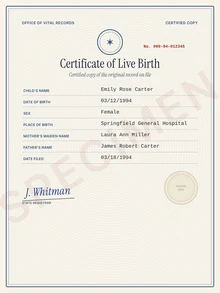
In the US, many states issue a short version (“short form”, “abstract”) and a full one (“long form”, a full copy of the record); in the UK there is the “short birth certificate”, with the person’s details only, and the “full birth certificate”, which includes the parents. For marriage, residence or nationality matters in Brazil, authorities usually need parentage, so the full version is generally the right one. Get the full version apostilled before translating: a new certificate means a new apostille and a new translation.
Can I drive in Brazil with a US, UK or Canadian licence?
Under CONTRAN Resolution 933/2022, drivers licensed abroad may drive for up to 180 days from entry with a valid foreign licence, an identity document and proof of the entry date, subject to an international agreement and reciprocity. If the issuing country is a party to the 1968 Vienna Convention – such as the UK – an International Driving Permit (PID) is also required. The US, Canada, Australia and Ireland are not parties to that convention. After 180 days residents must obtain a Brazilian CNH at the Detran; many Detrans ask for a sworn translation of the foreign licence – check in your state.
My document is bilingual (English and another language). What is translated for use in Brazil?
In Brazil every foreign-language text that is to take effect needs a sworn translation (CPC art. 192; Law 14,195/2021 art. 27) – including the English part of a bilingual document, e.g. English/French from Canada, English/Welsh from the UK or English/Spanish from Puerto Rico. The sworn translator works from the languages they are licensed for; send the complete document (front and back) and, if the authority accepts only one version, get that confirmation in writing.
Does my foreign certificate need to be recent for use in Brazil? Does the translation expire?
For residence permits, the Federal Police works with criminal record certificates issued no more than 90 days earlier. For marriage there is no federal deadline for foreign certificates, but many registry offices ask for recent ones – check first. US vital records have no “expiry date”, but a new certified copy is issued with a current date. A sworn translation has no statutory expiry; if the authority requires a more recent certificate, the new copy needs a new apostille and a new translation.
Are the apostille and stamps translated too?
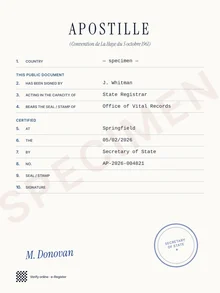
Yes, in both directions: we translate everything that is on the document when it reaches us – apostille, seals, stamps and “certified copy” notes – in a single translation. Foreign document for use in Brazil: apostille first in the issuing country, translation second, because every foreign text that is to take effect in Brazil needs a sworn translation (CPC art. 192; Law 14,195/2021 art. 27). Apostilles issued in the US and UK are usually in English (sometimes also French) and are part of the translation. Brazilian document for use abroad: the e-Apostila on the original is translated; an e-Apostila added later to the translation itself is not.
Is a US or UK e-Apostille valid in Brazil?
Yes. The HCCH advises that electronic apostilles be accepted by Convention parties, and CNJ Resolution 228/2016 requires acceptance of apostilles issued by member states. The UK issues e-Apostilles that can be checked at gov.uk/verify-apostille with the apostille date and number; some US states also issue electronic apostilles with their own online verification. Send the translator the original digitally signed PDF, not a screenshot or photo, so the signature and code can be checked.
FBI criminal record: who issues the apostille?
The FBI “Identity History Summary” is a federal document. The apostille is therefore issued not by a state Secretary of State but by the US Department of State’s Office of Authentications; state that Brazil is the destination country when applying. State or local police certificates follow the state route. After the apostille comes the sworn translation in Brazil. The Federal Police usually accepts criminal records up to 90 days after issue – factor in the FBI and apostille processing time when planning.
Do I need a translation for a WES or ECE credential evaluation?
Credential evaluation services set their own rules. WES asks for complete, word-for-word translations into English – or French for Canada – by a professional translator, not by the applicant, and does not accept translations of photocopies; in many countries the academic records must be sent directly by the institution. Check the document list in your WES account. For ECE or other services, follow their own instructions.
Overview and calculator: sworn translation English ⇄ Portuguese →
Official sources
- gov.br · e necessaria a legalizacao e
- govinfo.gov · CFR 2011 title8 vol1 sec103 2
- canada.ca · translation
- gov.uk · guide to supporting documents visiting the uk
- newzealand.embassy.gov.au · Attachingdocumentstranslationstoyourapplication
- cnj.jus.br
- cnj.jus.br · perguntas frequentes 5
- abmes.org.br · Resolucao cne ces 002 2024 12 19
- birmingham.gov.uk · order a birth certificate
- goias.gov.br · Resolucao Contran 933 2022
- gov.br · carteira internacional
- treaties.un.org · XI B 19.en
- gov.uk · verify apostille
- hcch.net · apostille
- travel.state.gov · criminal records
- wes.org · translation requirements for a wes credential ev
- canada.ca · guide 5269 applying study permit outside canada
Last reviewed: 6 November 2026, by Benedikt Schober (traduzme) · Rules and addresses checked against the official sources cited for each country.
 United States
 United Kingdom
 Canada
 Australia
 Ireland
 New Zealand
 South Africa
 India
 Nigeria
 Ghana
 Kenya
 Singapore
 Philippines
 Jamaica
 Trinidad & Tobago
 Guyana
 Malta
Send it today.
Get it back signed.
No sign-up, no commitment. The price is fixed before you pay.