.svg)
.svg)


Wedding Interpreter in Brazil: What It Costs and How a Bilingual Ceremony works 2026
A wedding interpreter in Brazil makes sure the half of the room that does not speak Portuguese lives the same ceremony as everyone else, at the same moment, without headsets and without delay. Our wedding interpreting starts at R$ 2,000 for a ceremony in the São Paulo region, and we work in every language our network covers, not only English.
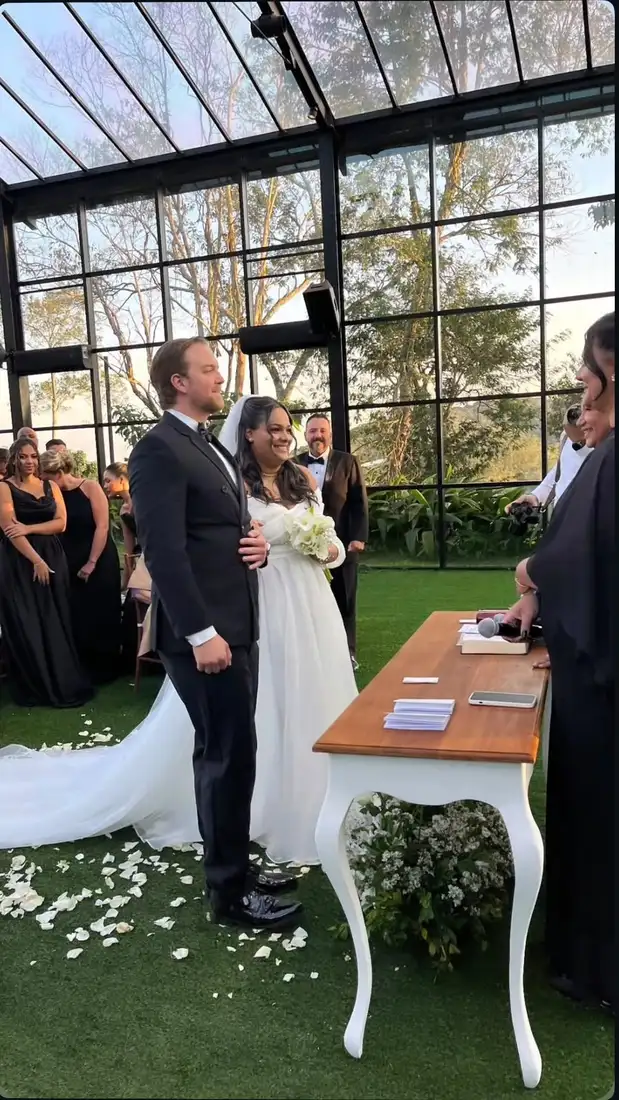
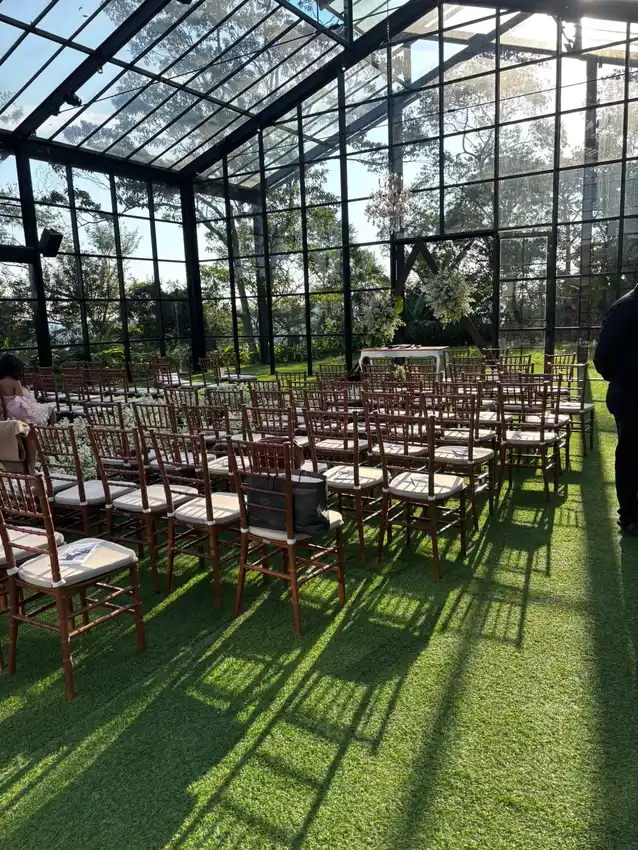
On 15 August 2026, at Mirante Juruá in Mairiporã, north of São Paulo, that job belonged to Julia. Around 80 guests, one English Portuguese wedding interpreter, no booth, no receivers. The bride's verdict afterwards, in two words: foi ótimo.
Below is the full picture: what a bilingual ceremony costs, what the price covers, how the preparation runs week by week, and what actually happened at that wedding.
Send your date, venue and languages and receive a quote within hours →
Bilingual wedding in Brazil: the case in six lines
Date: Saturday, 15 August 2026.Venue: Mirante Juruá, Mairiporã, in the Serra da Cantareira hills, about an hour from central São Paulo.Guests: around 80, a mixed Brazilian and English speaking crowd.Language: Portuguese into English, live, throughout the ceremony.Setup: one interpreter working beside the celebrant, no booth, no headsets, no receivers.After the ceremony: the couple invited the interpreter to stay for the dinner.
That last line matters more than it looks. It comes back at the end.
How much does a wedding interpreter in Brazil cost?
Wedding interpreting with us starts at R$ 2,000. That covers a ceremony in the São Paulo region with one professional interpreter, in the format used at Mirante Juruá: the interpreter arrives ahead of the guests, works through the ceremony, and stays for the photographs and the first part of the reception.
Four things move the number up from there, and all four are visible in the quote before you commit:
Hours. A ceremony is one thing. A ceremony plus speeches, toasts and a full reception is a working day, and it is priced as one.
A second interpreter. For long ceremonies combined with a full evening of speeches, two professionals rotate. Below that, one is the right answer and we will say so rather than sell you a second.
Travel. Ceremonies in the city of São Paulo carry no travel cost. Venues in the interior, on the coast or in another state add transport and, for early ceremonies far from the city, accommodation.
Language and rarity. English and Spanish are the most available pairs in Brazil. German, French, Italian, Hebrew, Mandarin and Arabic are rarer and priced accordingly, though we cover all of them.
What you will not find in our quotes: equipment you do not need. Most garden and chapel ceremonies with one foreign language work better without any.
What the price includes
- One professional interpreter, selected for your ceremony rather than assigned at random
- The interpreter profile in advance, with photo, background and a voice sample
- An introduction call between the couple and the interpreter before the date
- Preparation of the script, the readings, the vows and the pronunciation of every family name
- Coordination with your wedding planner or celebrant on position, timing and cues
- Confidentiality on everything shared with us
- Presence at the venue ahead of the guests, not five minutes before the aisle
Get your wedding quote → or send it straight to WhatsApp. Quotes come back within hours, not days.
Why a wedding interpreter in Brazil beats a translation app
Nobody hands their grandmother a phone during the vows.
A ceremony is the hardest environment there is for machine translation and the natural home of a trained interpreter. The celebrant speaks with rhythm and emotion, not in clean sentences. Names, family references and religious language carry weight that a literal rendering destroys. And the vows, the two or three sentences the foreign family crossed an ocean to understand, happen exactly once.
A professional delivers that meaning while the moment is still alive, in the register the couple chose, at the pace the ceremony is moving. That is the whole job, and it is decided long before anyone walks down the aisle.
Wedding interpreter without equipment: 80 guests, no headsets, no booth
Not every bilingual wedding needs a booth and receivers. This one did not, and that was a deliberate decision rather than a saving.
With one language direction and a ceremony where the celebrant and the couple speak in turn, consecutive interpreting is the cleanest solution. The celebrant speaks, the interpreter renders it in English, both language groups hear the entire ceremony, and the event keeps its own rhythm instead of the rhythm of a sound system.
Do you need interpreting equipment for a wedding ceremony?
Equipment earns its place in three situations: two foreign languages at the same ceremony, a large indoor venue where a second voice would compete with the PA system, or a couple who want the interpretation to be inaudible to Portuguese speaking guests. Those are cases for simultaneous interpreting with a portable transmitter and receivers, which we quote as a separate line so you can see exactly what it adds.
For a garden ceremony of 80 people with a single language pair, adding equipment would have added cost and cables and taken away intimacy. The mechanics of both formats are on our page about consecutive interpreting.
Bilingual English and Portuguese wedding translator providing professional interpretation during a wedding ceremony and celebration.
Wedding interpreter for every language, not only English
English is the most requested pair at Brazilian weddings, and it is far from the only one we do.
Our network covers more than 700 interpreters in over 25 languages, which in wedding terms means Spanish for Argentine, Colombian and Mexican families, German, French, Italian, Dutch, Hebrew for religious ceremonies, Mandarin, Japanese, Arabic and Portuguese Sign Language, Libras, for deaf guests.
Ceremonies with two foreign languages
They happen more often than you would think: a Brazilian bride, a German groom, and a guest list with cousins from Buenos Aires. That is two interpreters and, usually, a portable system so each language group listens on its own channel without three voices overlapping in the garden. It is a solved problem, it just has to be planned rather than improvised, and it is the one case where equipment is genuinely worth the line item.
Tell us the language combination when you write. It is the single detail that changes the structure of the quote the most.
How we prepare a wedding interpreter for a bilingual ceremony
This is the part that never appears on a price list, and it is the part that decides how a ceremony feels.
- The couple chooses the interpreter. Before anything is confirmed, you receive the profile of the professional we propose: photo, professional background and a voice sample. At a wedding, the interpreter's voice becomes the voice of the ceremony for half the guests. Nobody should have to accept that voice unheard.
- Interpreter and couple are introduced early. Not the week before. Early enough to talk, ask questions and build a working relationship, so that on the day nobody is meeting anyone for the first time.
- The script comes in advance. Order of service, readings, vows, the celebrant's text, the names of parents and grandparents, and the pronunciation of every name a Brazilian or an American tongue would otherwise get wrong.
- The couple decides what gets interpreted. Interpreting every second doubles a ceremony. Most couples choose the celebrant, the vows and the exchange of rings, and leave music and silence untouched.
- The wedding planner is part of the plan. Where the interpreter stands, when she enters, when she steps out of the photographer's frame. Julia's own highlight of the day was how well the planning team worked, which is what happens when coordination is settled before the guests arrive.
- Contingencies are agreed before the day. No ceremony follows its script to the letter. A reading moves, the celebrant adds a line, someone speaks longer than planned. An experienced interpreter absorbs that without the room ever noticing, because the structure and terminology were prepared rather than improvised.
When to book a wedding interpreter: a timeline that works
Three months out. Send the date, venue and languages. This is when the best availability exists, especially for Saturdays in high season and for languages other than English.
Six to eight weeks out. Choose the interpreter from the profiles, confirm the booking, and hold the introduction call with the couple.
Two to three weeks out. Send the order of service, the readings, the vows and the family names. This is where the quality of the ceremony is actually built.
The week of the wedding. Final running order from the planner, arrival time, dress code, and confirmation of whether the reception is covered.
Short notice bookings are possible when someone is available, and we take them. You simply lose the preparation that makes the difference.
What our wedding interpreter said about the day
We asked Julia to write down her account of the ceremony. Translated from Portuguese:
"We had time to talk and to breathe together before the ceremony. By the time it began, we understood each other's rhythm, and we carried each moment the way it needed to be carried."
"Everyone was open hearted, welcoming and generous, and the planning team was excellent throughout the whole process."
"Being the bridge that allowed other people to follow that moment and take part in it meant a great deal to me. It was a wonderful experience, and I will keep it with me."
That is the standard we hold wedding work to. Not a service delivered, a moment that belonged to everyone in the garden.
Wedding interpreter or sworn translator in Brazil: two different jobs
Worth clarifying before you book the wrong one.
The wedding you are picturing, with the garden, the vows and the guests, is a celebration. The legal marriage in Brazil happens separately, at a cartório, with documents. Where one of the parties does not understand Portuguese, registry offices commonly require a sworn public translator, a tradutor público juramentado, to be present and to sign, and foreign documents such as birth certificates generally require sworn translation. Requirements differ between states and between individual registry offices, so confirm with yours early.
Foreign couples marrying in Brazil therefore usually need two things: sworn translation for the paperwork and a wedding interpreter for the ceremony. Different professionals, different qualifications. We handle both and will tell you plainly which one your situation calls for.
Wedding interpreter in São Paulo and beyond: why couples call us first
We interpret conferences, negotiations, audits and trade fairs. Weddings are the one format where the linguistic work is only half the job.
There is no second take and no rehearsal with the real audience. The interpreter stands inside the most photographed twenty minutes of two people's lives, and the mark of a good one is that afterwards nobody remembers she was there, except the guests who understood every word.
That is why this work is its own service at traduzme, with its own preparation routine, its own interpreter selection, and one rule we do not bend: the couple meets the interpreter before they book.
English to Portuguese wedding interpreting in São Paulo, Mairiporã and beyond
We cover the city of São Paulo and the venues around it, Mairiporã and the Serra da Cantareira, Campinas, the coast, and destination weddings in the Northeast, in Minas and in the South. Wherever the ceremony is, weddings are where we want to be your first call.
The full service is on our wedding interpreting page. If you are arriving from abroad and need language support beyond the ceremony, our guide to hiring a Portuguese interpreter in Brazil covers meetings, family visits and everything around the date.
What happens after you write to us
No forms to fight with and no sales sequence.
- You send the date, the venue, the languages and roughly how many guests. Four lines is enough.
- Within hours, you get a quote with the price, the hours covered and whether we recommend equipment or not.
- You receive interpreter profiles with photo, background and a voice sample, and you choose.
- We introduce you to your interpreter and start the preparation.
Send your wedding details and get a quote within hours →
Or message us on WhatsApp right now at +55 (61) 99803-8363, Monday to Saturday, 8am to 6pm. Email oi@traduzme.com.br.


.svg)

.webp)